


What should the humidity be in your house (and your bathroom)?
Keep your house below 60% relative humidity, ideally between 30 and 50%, the EPA says. A shower will push your bathroom above that for a while, and that's normal. What counts is how fast it comes back down. A cheap hygrometer will show you.

Sources: US EPA and its ENERGY STAR program, CDC, National Weather Service, US Department of Energy (Building America Solution Center), Minnesota Department of Health, University of Missouri, University of Kentucky and University of Hawaiʻi Extension, Home Ventilating Institute, National Bureau of Standards, Journal of Building Physics. Last reviewed November 19, 2026.
Pop quiz. Which air holds more water: a 30°F winter morning at 100% humidity, or an 80°F summer afternoon at 50%?
The summer afternoon, and it isn't close. By our math it holds almost three times as much water. The National Weather Service uses that exact pair to show why the humidity reading can mislead you.7
So yes, there's a right humidity for your house. But the number on the meter only makes sense next to the temperature, and your bathroom plays by its own rules for an hour after every shower.
On this page
- 01Indoor humidity at a glance
- 02What's a good humidity level for a house?
- 03Is 70% humidity too high inside a house?
- 04Can indoor air be too dry?
- 05Relative humidity or dew point: which number should you watch?
- 06How much water does a lived-in home add to its air?
- 07Why does your bathroom spike after a shower, and how long should it take to clear?
- 08How does humidity change between winter and summer?
Indoor humidity at a glance
| What | The number | Source |
|---|---|---|
| Your house, most of the year | Below 60%, ideally 30–50% | EPA |
| A tighter line | No higher than 50%, all day long | CDC |
| Running a humidifier | Don't take the room above 50% | EPA |
| Winter, in a cold climate | 20–40%, to keep windows and walls dry (ENERGY STAR: 30–40%) | Minnesota Department of Health · ENERGY STAR |
| Above 60% | "likely to result in condensation in the building" | EPA |
| Bathroom fan after a shower | At least 20 minutes; a one-hour timer for humidity control | Home Ventilating Institute · DOE Building America Solution Center |
| Summer dew point, how it feels | 55°F or less: dry · 55–65°F: sticky · 65°F or more: oppressive | National Weather Service |
| A hygrometer | About $10–$50; give it 15–30 minutes to settle | EPA · University of Kentucky Extension |
Indoors, keep it under 60%. A bathroom will rise above that every shower; watch how fast it falls back.
What's a good humidity level for a house?
A good humidity level for a house is below 60%, and ideally between 30 and 50%. That's the EPA's range for indoor relative humidity.1 The CDC draws a tighter line: no higher than 50%, all day long.2
- If you run a humidifier, the EPA says not to take the room above 50%.3
- In winter in a cold climate, the Minnesota Department of Health suggests 20 to 40%, "to keep indoor surfaces as dry as possible."4 Cold glass and cold walls are where moisture lands: "When warm, humid air contacts a cold surface, condensation may form."6
Is 70% humidity too high inside a house?
Yes. 70% indoors is well past the EPA's 60% line, and the EPA's mold course is plain about what happens above it: relative humidity greater than 60% "is likely to result in condensation in the building, which can lead to mold growth."5
Start by finding where the water comes from. The EPA lists humidifiers, steam radiators, clothes dryers, gas stoves, cooking and showering among the things that raise indoor humidity.6 If you can see mold already, our guide to mold in the bathroom covers cleanup.
Can indoor air be too dry?
Indoor air can get too dry, and winter is when it happens. The EPA's ideal range starts at 30%, and its humidifier guide names what dry, heated air does around the house: static electricity, peeling wallpaper, and cracks in paint and furniture.3
If you add moisture back, stop at 50% and check it with a hygrometer. If water starts condensing on windows, walls or pictures, the EPA says to move the humidifier, turn it down or use it less.3
Relative humidity or dew point: which number should you watch?
Use relative humidity to keep your home in range, because that's the number the EPA's 60% line is written in.1 Use dew point to understand what's going on, because it tracks how much water is actually in the air.
Relative humidity is how full the air is compared with what it could hold at its temperature. Warm air holds more than cool air,11 so the same water reads as a lower percentage on a warm day. That's how 80°F at 50% can be far wetter than 30°F at 100%.7 "The higher the dew point, the muggier it will feel," the National Weather Service says, and in summer it reads like this:7
- 55°F or less: dry and comfortable
- 55 to 65°F: sticky, with muggy evenings
- 65°F or more: lots of moisture in the air, becoming oppressive
Dew point is also the temperature where water starts coming out of the air. Cool air (or a surface) below it, and you get fog, droplets or rain.7 That's your steamed-up mirror: the glass is colder than the dew point of the air your shower just made.
Our Bathroom Biome check uses your local dew point, not the humidity on your weather app, for exactly this reason.
How much water does a lived-in home add to its air?
In cold weather, a lived-in house can hold 3.4 to 4.9 more grams of water per cubic meter than the air outside: about a 2-liter soda bottle's worth floating around a 2,000-square-foot house, by our math. That's the high end of a study of 220 Finnish homes.8
The team measured the indoor air of 171 houses and 49 apartments, some for up to 28 months, and asked how much more water a home's air holds than the air outside. That gap is called moisture excess: the water a household adds on top of the weather.
What they found:
- Cold weather (5°C, about 41°F, or colder): the study's high-end figure (its top-10% level) was 3.4 to 4.9 extra grams of water per cubic meter of air in houses, depending on how they were built, and 2.4 to 3.6 in apartments.
- Warm weather (15°C, about 59°F, or warmer): 0.3 to 2.6 in houses, 0.5 to 1.5 in apartments.
- The number of people living in a home didn't change its average. Neither did how airtight its walls were.8
One catch: these were whole homes in Finland, not bathrooms, and every shower adds its own burst on top. Think of the study as the baseline your bathroom starts from. Our Bathroom Biome check uses it that way, with a starting point set below their cold-weather figures: 2.0 grams when it's cold (theirs: 3.4 to 4.9), sliding to 0.5 when it's warm (the low end of their 0.3 to 2.6).
Why does your bathroom spike after a shower, and how long should it take to clear?
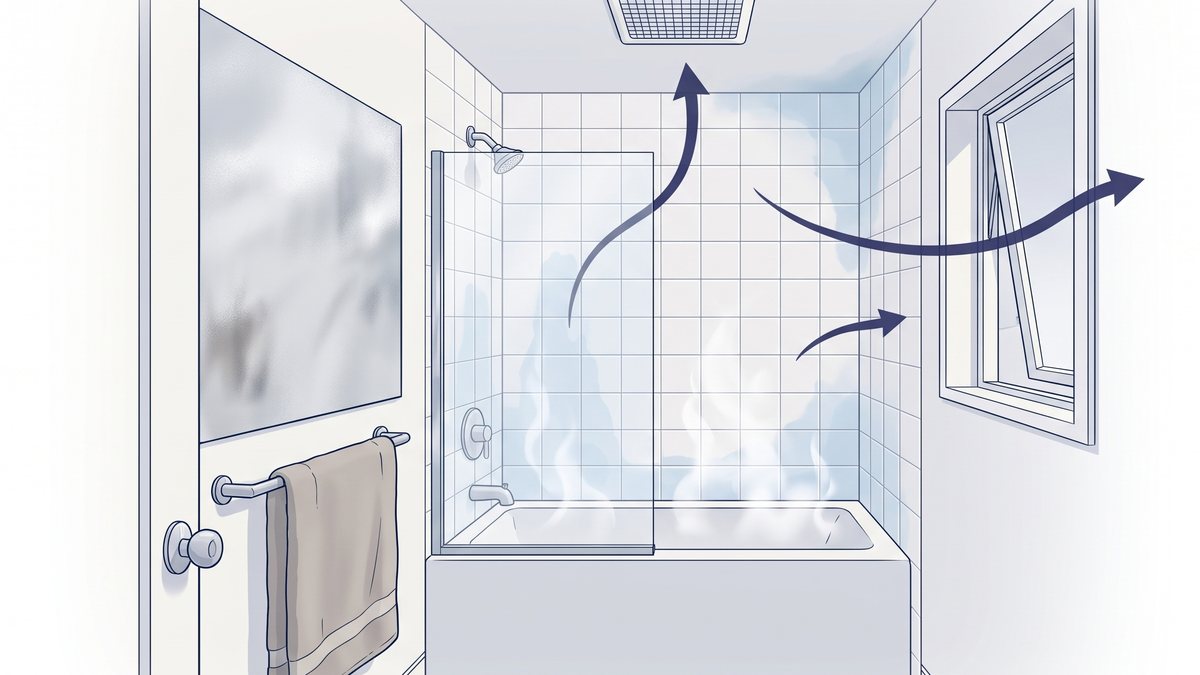
A hot shower fills a small room with warm, wet air. When that air touches something cooler (the mirror, the window, the tile), water can condense out of it.6 How fast the room clears depends on your fan, your window and the air outside, and there's no official stopwatch.
The guidance that does exist:
- The Home Ventilating Institute: keep the fan running "for a minimum of 20 minutes after each use of the bathroom."9
- The Department of Energy's building guide: "It is recommended to leave the fan running for one hour after a shower for effective humidity control," on a timer that shuts it off for you.10
Your own bathroom will tell you more than either rule. Read a hygrometer before you shower, then 30 and 60 minutes after. If it's back under 60% by the hour mark, your bathroom clears its steam within the hour of fan time the Department of Energy's guide recommends. If it's still high, the steam is hanging around too long. (Why 30 minutes and not right away? Cheap meters need time to catch up. More on that below.)
No meter? Use your towel. A towel that's dry a couple of hours after a shower says the room clears well. One that's still damp at bedtime says it doesn't.
For fan sizing, the fan-timer details and the tissue test that shows whether your fan pulls air, see mold in the bathroom.
How does humidity change between winter and summer?
In winter, the outside air is the dry part, so letting some in helps, and the trouble moves to cold surfaces. In summer, the outside air is the wet part, so opening up can make things worse, and cooling or dehumidifying does the drying.
The EPA's mold course puts it in one line: to cut the moisture in the air, "increase ventilation (if outside air is cold and dry), or dehumidify (if outdoor air is warm and humid)."5
- In winter, watch the glass. Cold windows are where indoor moisture shows up first, which is why Minnesota's health department aims for 20 to 40% in winter.4 Our mold guide covers condensation on the bathroom window in winter.
- In summer, cool the air. Cool air holds less moisture than warm air, and an air conditioner pulls water out as it cools, University of Missouri Extension explains. Keep windows and doors closed while it runs.11
- In a muggy week, fresh air helps less. Ventilation dries a house "when the air outside is drier than that inside," as Missouri's guide puts it.11 When it isn't, a dehumidifier or the AC does the job.5,11
How do you check the humidity in your home?
You check indoor humidity with a hygrometer, a small humidity meter. The EPA puts them at about $10 to $50 at many hardware stores.1 A few habits make a cheap one read true:
Give it time. Most of these meters need 15 to 30 minutes in a new spot before the reading settles. A glance after a minute or two "is improper and results in inaccurate data," University of Kentucky Extension warns.12
Keep it out of the sun and out of the shower. A meter in direct sun won't read like one in the shade, and humidity above 95% "can seriously affect the accuracy and stability of these instruments," especially for more than a few hours.12 A shelf or the back of the door beats the shower caddy.
Expect a few points of wiggle. Plus or minus 5% is "the norm for low-cost devices," the Kentucky guide says.12 So a reading of 58% and one of 62% could be the same room.
Check it with table salt. See the next section.
The salt test: check your hygrometer for pennies

Damp table salt holds the air above it at about 75% humidity. Measurement scientists have relied on this for decades: the National Bureau of Standards (now NIST) put saturated salt water at 75.3 to 75.5% at room temperature.13 Here's the home version from University of Kentucky Extension:12
Put about half an inch of plain table salt in a cup. Add just enough water to make a mushy paste, and stir.
Set the cup and your hygrometer in a clear zip-top bag or airtight container, out of direct sun. Don't let the meter touch the salt.
Wait one to two hours, until the reading stops moving.
Compare it with 75%. If your meter reads 77%, subtract 2 points from its readings from now on. If it reads 73%, add 2.
When University of Hawaiʻi researchers ran a version of this test on low-cost meters, the ready-made ones, including one that cost $2, read within their rated accuracy with no adjustment.14
How do you lower the humidity in your house?
Dry the air with an air conditioner or a dehumidifier, cut the water you add, and let outside air in only when it's drier than yours.
Vent the clothes dryer outdoors. The EPA puts dryers on its list of appliances to vent outside.1
Use humidifiers less. It's on the Minnesota Department of Health's list for cutting condensation.4
Open up only when the air outside is drier. That usually means a cold, dry day, not a muggy one: the EPA's mold course says to ventilate when outside air is cold and dry, and dehumidify when it's warm and humid.5
No fan or window in the bathroom? The shower-by-shower routine is in mold in the bathroom.
We've been working on something for this.
Get first access. And the lab results.
You're on the list. Your first email is on its way.
Questions
What humidity should a bathroom be?
The same as the rest of the house: below 60%, ideally 30 to 50%, the EPA says. It will rise above that while you shower. Run the fan at least 20 minutes afterward (Home Ventilating Institute), or a full hour on a timer, as the Department of Energy's guide recommends. Then check that the room drops back under 60%.
Is 55% humidity too high?
It's under the EPA's 60% ceiling but above its ideal range of 30 to 50%, and above the CDC's 50% line. Right after a shower, a bathroom will read higher than that anyway. As an all-day level for the house, it's on the high side of the guidance.
Is 40% humidity too low?
No. 40% sits inside the EPA's ideal range of 30 to 50%. In a cold-climate winter it's the top of the range, though: ENERGY STAR suggests 30 to 40% during the heating season to prevent window condensation, and Minnesota's health department 20 to 40%. If your windows run wet, go lower.
Does a dehumidifier help in a bathroom with no fan?
Yes. The EPA and the CDC both list dehumidifiers for keeping humidity down. Run it with the bathroom door and any window closed so it dries that room, as University of Missouri Extension advises for dehumidifiers and air conditioners.
Why does my bathroom mirror fog up?
Because the glass is colder than the dew point of the air your shower made. When warm, humid air touches a cold surface, condensation can form, the EPA explains. A fan, an open door or a warmer room helps it clear.
How accurate are cheap hygrometers?
Plus or minus 5% is the norm for low-cost meters, according to University of Kentucky Extension, and in a University of Hawaiʻi test the ready-made ones read within their rated accuracy. You can check yours at home with damp table salt, which holds the air at about 75%.
Keep reading
Sources (15)
- US Environmental Protection Agency. "A Brief Guide to Mold, Moisture and Your Home." EPA, last updated February 18, 2026. epa.gov
- Centers for Disease Control and Prevention. "Mold." CDC, September 26, 2024. cdc.gov
- US Environmental Protection Agency. "Use and Care of Home Humidifiers." EPA, last updated April 29, 2026. epa.gov
- Minnesota Department of Health. "Mold and Moisture." MDH, last updated February 19, 2026. health.state.mn.us
- US Environmental Protection Agency. "Mold Course Chapter 9: Prevention." EPA, last updated November 10, 2026. epa.gov
- US Environmental Protection Agency. "Mold Course Chapter 2: Why and Where Mold Grows." EPA, last updated November 10, 2026. epa.gov
- National Weather Service, La Crosse, WI office. "Dew Point vs Humidity." NOAA, undated. weather.gov
- Vinha J., Salminen M., Salminen K., Kalamees T., Kurnitski J., Kiviste M. "Internal moisture excess of residential buildings in Finland." Journal of Building Physics 2018;42(3):239–258. doi.org
- Home Ventilating Institute. "How Much Ventilation Do I Need?" HVI, undated. hvi.org
- Pacific Northwest National Laboratory for the US Department of Energy. "Bathroom Exhaust Fans." Building America Solution Center, last updated December 4, 2022. basc.pnnl.gov
- Eubank W., Feather B. "How to Prevent and Remove Mildew — Home Methods" (GH5928). University of Missouri Extension, April 1998, reviewed September 2017. extension.missouri.edu
- Duncan G., Gates R., Montross M. "Measuring Relative Humidity in Agricultural Environments" (AEN-87). University of Kentucky Cooperative Extension Service, February 2005. publications.ca.uky.edu
- Greenspan L. "Humidity fixed points of binary saturated aqueous solutions." Journal of Research of the National Bureau of Standards, Section A: Physics and Chemistry 1977;81A(1):89–96. nvlpubs.nist.gov doi.org
- Kurasaki R., Naruse K. "Calibration of Humidity Sensors for Agriculture" (FST-70). University of Hawaiʻi at Mānoa, College of Tropical Agriculture and Human Resources, December 2023. ctahr.hawaii.edu
- US Environmental Protection Agency, ENERGY STAR. "Dehumidifiers." ENERGY STAR, no date shown. energystar.gov