


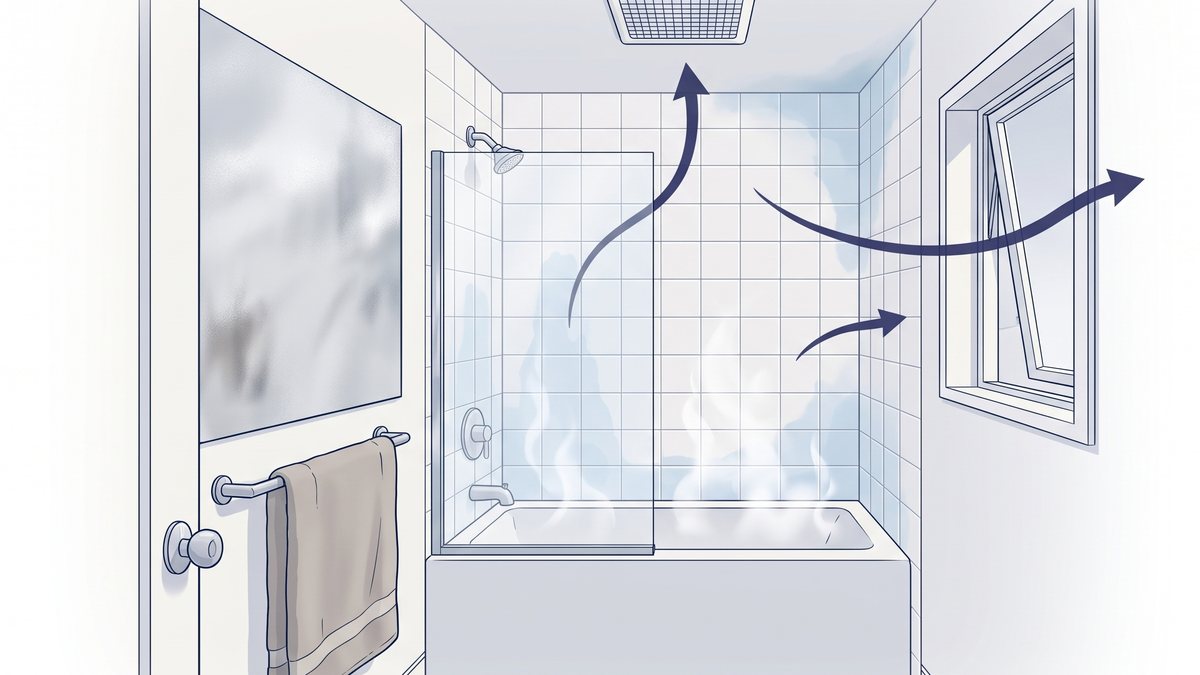
Why won't my towels and bath mat dry?
Because your bathroom can't carry the water away fast enough. Humid air that barely moves dries fabric slowly, and a towel bunched on a hook or a mat lying flat on the floor keeps much of its surface out of the air.

Spread them out, run the fan at least 20 minutes after you shower, and keep humidity below 60%.
Sources: Empa (the Swiss Federal Laboratories for Materials Science and Technology), the Hyogo Prefectural Institute of Life Science (Japan), US EPA, Home Ventilating Institute, University of Missouri Extension and the American Cleaning Institute. Last reviewed November 19, 2026.
On this page
What dries a towel, and what stops it
| What changes | What the lab found | Source |
|---|---|---|
| One side blocked (a mat flat on the floor, a towel folded tight) | Fabric that could dry from one side only took 45% longer on average, and up to 69% longer | Empa |
| Moving air | A fan blowing on wet shirts cut drying time by 1.5 to 3 hours | Hyogo Prefectural Institute of Life Science |
| A gap between layers | With no fan, shirts on thick hangers dried more than 30 minutes sooner than on wire hangers | Hyogo Prefectural Institute of Life Science |
| Warmth | On a skin-warm surface (35 °C, 95 °F), fabric dried about 7 times faster on average | Empa |
| How much water it holds | The more water a fabric held, the longer it took to dry | Empa (our reading of its results) |
| Room humidity | Keep it below 60%, ideally 30 to 50% | US EPA |
| The fan after a shower | At least 20 minutes after each use | Home Ventilating Institute |
The lab tests used shirts and sportswear fabrics. Towels and mats dry by the same evaporation, so the same levers apply.
Why won't my towels dry in the bathroom?
Because you're drying a wet towel in a room full of wet air. Indoors, how fast laundry dries comes down to three things: the air's warmth, its humidity, and how much it moves, says a consumer-research lab run by Japan's Hyogo Prefecture.2 A shut bathroom after a shower gets two of them wrong.
The air is full of the water you just put into it. Cooking, laundry and bathing "may add 2 gallons (7.6 liters) or more of water a day to the house, unless circulation is adequate," the University of Missouri Extension says.3 And that air isn't going anywhere unless a fan or a window moves it.
That's how the towel you used at 7 am ends up still clammy at 7 pm. The fix is the air around it, not a new towel.
Is a towel hook or a towel bar better for drying?
A bar, with the towel spread as wide as it'll go. On a hook, most of the towel is pressed against itself.

Nobody seems to have timed a hook against a bar. Two lab tests on wet fabric point the same way:
- A blocked side slows everything down. At Empa, Switzerland's federal materials lab, wet fabric wrapped around a plastic tube could only dry outward. It took 45% longer on average than the same fabric drying from both sides, and up to 69% longer.1
- Layers need a gap. At the Hyogo lab, with no fan running, shirts on thick hangers, which hold the front and back apart, dried more than 30 minutes sooner than shirts on wire hangers.2
A towel on a hook hangs in bunched layers pressed against each other, so most of it is a blocked side. Folded over a bar, it's two layers facing each other across a narrow gap. Spread across a wide bar or the shower rod, every inch gets air. The University of Missouri Extension keeps it short: "Spread out washcloths and damp towels."3
| How it hangs | What the air reaches | Speed |
|---|---|---|
| Spread in one layer (wide bar, shower rod, drying rack) | Both faces, edge to edge | Fastest |
| Folded in half over a bar | The outer faces fully; the inner faces only through the gap between them | Slower |
| Bunched on a hook or a door hook | The outer layers; the middle barely | Slowest |
Our reading of the two lab tests above, not a timed test of towels.
Does running the bathroom fan help towels dry?
Yes. Turn it on with the shower and leave it running at least 20 minutes after you're done: that's the Home Ventilating Institute's rule.5 The EPA's version is simpler: run the bathroom fan or open the window whenever you shower.4
Moving air beat every other change in the Hyogo tests. A fan blowing on the laundry cut drying time by 1.5 to 2.5 hours for quick-dry shirts and by 2 to 3 hours for cotton ones, and low or medium speed made no clear difference.2 Your exhaust fan works a little differently: it pulls the wet air out so drier air can come in. "Air movement is excellent at removing moisture," as the University of Missouri Extension puts it.3
- Put it on a timer. HVI recommends a timer or other control that keeps the fan running at least 20 minutes after each use.5
- Check it's pulling air. A fan that won't hold up a tissue isn't doing much for your towels. The two-minute test is in our guide to mold in the bathroom, with fan sizes.
- No fan? Open the window while you shower,4 and hang towels to dry in another room (more in the questions below).
Why does a damp towel start to smell?
Because it stayed wet too long. When laundry takes a long time to dry, bacteria multiply in it, and that's where the smell comes from, the Hyogo lab explains.2 "Fabrics dried slowly may get sour and musty smelling," says the University of Missouri Extension.3
Already smells? Washing it again and drying it fully is the fix: see how to get the musty smell out of towels and how to wash towels.
Why does a big towel take so long to dry?
Because it's carrying more water. In Empa's lab tests, the fabrics that soaked up the most water took the longest to dry.1 A big bath sheet simply starts with more to lose.
Two ways to shorten the wait:
- Spin it longer. At the Hyogo lab, a 9-minute spin instead of a 5-minute one took about 30 minutes off drying time.2 For your washer's settings, see how to wash towels.
- Add warmth. Warm fabric gives up its water far faster. That's the idea behind a heated towel rail (the lab number is in the questions below).
Why does my bath mat stay wet?
Because it's lying on the floor. A mat flat on tile can only dry from the top, and that's the blocked-side problem from Empa's test: 45% longer on average for fabric that dries from one side only.1

Lift it after your shower. Hang it over the tub edge or a towel bar so air reaches both sides.
Let the floor dry too. If the tile under the mat is wet, wipe it before the mat goes back down.
Run the fan for the full 20 minutes.5
Wash it about once a week and dry it all the way through. The settings are in how to wash a bath mat.
Where should you hang wet towels in a small bathroom?
Wherever a towel can hang open in moving air. In a small bathroom that's usually a wide bar, the shower rod once the water's off, or a drying rack just outside the door.
- One towel, one bar. Spread it, don't fold it. Two on one bar are back to blocked sides.
- Skip the back-of-door hooks for wet towels. Bunched is slowest.
- Swap when you need to. "Towels need to be allowed to dry before they are used again," the American Cleaning Institute says.6 If yours is still damp, use a dry one and spread the damp one out.
We've been working on something for this.
Get first access. And the lab results.
You're on the list. Your first email is on its way.
Questions
Should you hang towels outside the bathroom?
Does a heated towel rail help towels dry?
Yes. In Empa's lab tests, wet fabric on a skin-warm surface (35 °C, 95 °F) dried about 7 times faster than on a room-temperature one, on average.1 Spread the towel over the rail rather than bunching it.
Should you leave the bathroom door open after a shower?
How long should a towel take to dry between showers?
Hours, not minutes. In the Hyogo lab, at 68 °F and 65% humidity, a cotton sweatshirt hung indoors still wasn't dry after six hours.2 If your towel is still damp at your next shower, spread it out, run the fan longer, or move it to a drier room.
Keep reading
Sources (6)
- Jerkovic I., Psikuta A., Ebrahimi S., Baumann J., Camenzind M., Annaheim S., Rossi R.M. "Drying Performance of Fabrics on the Human Body." Materials 2025;18(11):2655. pmc.ncbi.nlm.nih.gov doi.org
- Hyogo Prefectural Institute of Life Science. "Drying laundry indoors" (Japanese title 洗濯物の室内干し; English title our translation). Journal of the Japan Research Association for Textile End-Uses (繊維製品消費科学) 2006;47(11):681–685. doi.org
- Eubank W., Feather B. "How to Prevent and Remove Mildew — Home Methods" (GH5928). University of Missouri Extension, April 1998, reviewed September 2017. extension.missouri.edu
- US Environmental Protection Agency. "A Brief Guide to Mold, Moisture and Your Home." EPA, last updated February 18, 2026. epa.gov
- Home Ventilating Institute. "How Much Ventilation Do I Need?" HVI, undated. hvi.org
- American Cleaning Institute. "Do I need to wash this?" American Cleaning Institute (cleaning-products industry group), no date shown. cleaninginstitute.org