


What's the black gunk in my shower head?
Black gunk in a shower head is usually a slimy film of bacteria called biofilm, crumbs from a worn rubber washer, or manganese from the pipes. Pinch a speck: rubber smears between your fingers.5,2,4

The pale crust is hard-water scale. Soak the head overnight in white vinegar, clear the holes with a pin, and repeat every few months.1,3,15,17
Sources: US EPA, CDC, US Geological Survey, New Jersey Department of Health, UK Health and Safety Executive, Loudoun Water, Prince William Water, City of Norfolk, University of Colorado Boulder, Northwestern University, University of Washington, National Jewish Health, American Standard, PNAS, mBio, Frontiers in Microbiomes, Annals of the American Thoracic Society. Last reviewed November 19, 2026.
On this page
Shower head gunk at a glance: what it is and how to tell
| What you see | What it usually is | The quick check | Source |
|---|---|---|---|
| White, tan or gray crust around the holes | Mineral scale: calcium and magnesium from hard water | A flake dropped in white vinegar bubbles or dissolves within a day | USGS · Loudoun Water |
| A slick, slimy dark or pinkish film | Biofilm: bacteria living together in a film | It wipes off as slime | City of Norfolk · CU Boulder |
| Black specks that smear | A rubber washer, gasket or O-ring breaking down | Pinch it: rubber smudges between your fingertips | Prince William Water · Loudoun Water |
| Black or brown grit or stains that don't smear | Manganese or silt from the pipes | No smear; black or brown stains on fixtures | Prince William Water · US EPA |
| Fine black granules | Carbon from a water filter cartridge | You have a carbon filter on that line | Loudoun Water |
| Reddish-brown grit or stains | Iron or rust | Orange or red stains | US EPA · Loudoun Water |
Most shower-head gunk is a cleaning job: a vinegar soak for the crust, a scrub for the slime, a new washer for the crumbs.
What is the black stuff in my shower head?

Unscrew a shower head that's been up for a year and you'll probably find a mix of chalky crust, slick dark film and maybe a few black crumbs. Only the film is alive.
Here's how to tell what you've got in about a minute:
Pinch a black speck. "Specks that can be smudged between fingertips indicate degrading rubber," says Prince William Water, a Virginia utility. Rubber washers, gaskets and O-rings wear down in contact with the chlorine and chloramine in tap water.2 If it won't smear, it's more likely silt or manganese.2
Drop a pale flake in vinegar. That crust is usually hard-water scale, the calcium and magnesium the US Geological Survey says hard water leaves on "plumbing, fixtures, and water heaters."3 Loudoun Water's test: calcium "will bubble or dissolve within 24 hours" in a little distilled vinegar. Plastic won't dissolve.1
Wipe the face. A slick, slimy film is biofilm. The City of Norfolk describes airborne bacteria that leave "a pinkish or dark gray film" on wet surfaces, shower heads included.5
If the specks come from a washer, swap it for a chloramine-resistant one.1 If you're on a private well and see black staining everywhere, a test is worth it: the EPA tells well owners who think their water may be contaminated to have it tested by a certified lab.4 Hard water itself isn't a health concern, the USGS says, "but it can be a nuisance."3
What's actually living inside a shower head?
A whole little ecosystem, and scientists have swabbed hundreds of them. The inside of a shower head is "moist, warm, dark, and frequently replenished with low-level nutrient resources," as one research team put it, which is about as cozy as it gets for bacteria.6
Three studies, three surprises:
| Study | What they swabbed | What they found | Source |
|---|---|---|---|
| University of Colorado, 2009 | 45 shower heads in nine US cities | In many of them, mycobacteria and other bacteria that can cause infections in vulnerable people were built up to more than 100 times the levels in the water feeding the shower. Legionella, the one people worry about most, turned up in only 3 of about 6,000 DNA sequences | Feazel et al., PNAS 2009 |
| CU Boulder citizen science, 2018 | 656 homes: 606 in the US, 50 in Europe | Mycobacterium was consistently the most abundant group of bacteria. City water had more than twice as much as well water, and US shower heads had 2.3 times as much as European ones | Gebert et al., mBio 2018 · CU Boulder |
| Northwestern, 2024 | 92 shower heads and 34 toothbrushes | 614 kinds of viruses, most never seen before. They infect bacteria, not people | Huttelmaier et al., Frontiers in Microbiomes 2024 · Northwestern |
Why city water? Mycobacteria handle chlorine better than most bacteria. In countries and homes where water carries more chlorine-based disinfectant, mycobacteria face less competition, the CU Boulder team explains.8,7
Mycobacterium is a big family. The genus has nearly 200 species, and they differ in how they live and whether they cause disease.7 Finding the family name in a swab isn't the same as finding something harmful.
The material matters a little. In the 2018 study, mycobacteria made up about half as much of the bacteria in plastic shower heads as in metal ones. The researchers think plastic feeds other bacteria that crowd mycobacteria out.7,8 It's one study of relative amounts, so treat it as interesting, not as a shopping rule.
And the viruses? Northwestern's Erica Hartmann called the haul "absolutely wild." The good news, in Northwestern's words: "these viruses don't target people. They target bacteria."10 The team found more viruses that infect mycobacteria than any other kind, and Hartmann thinks they could one day be put to work cleaning pathogens out of plumbing.10
Can a dirty shower head make you sick?
For most people, no. "Most people are not susceptible to NTM," the University of Washington's environmental health department writes. The risk falls on "a small percentage of elderly people and those with other chronic lung diseases or weakened immune systems."12
NTM stands for nontuberculous mycobacteria. The CDC says they live in soil, dust and water, including inside building pipes. People can breathe them in when contaminated water turns to mist, like the steam from a shower head, and the infections don't typically spread from person to person.11
The link between shower heads and illness is an association, not proof:
- In Washington and Oregon, researchers found NTM in shower spray more often in the homes of people with a mycobacterial lung disease than in matched homes of healthy people.13 The study's senior researcher, Gerard Cangelosi, stressed that it doesn't prove the shower heads caused anyone's illness, which had been diagnosed months or years before the samples were taken.12
- The 2018 map of shower-head mycobacteria lined up with where that lung disease is most common, including Florida, Hawaii, southern California and the mid-Atlantic. The authors call their results "correlative."7
"Microbes are everywhere, and the vast majority of them will not make us sick," says Northwestern's Hartmann.10
If you or someone you live with has a chronic lung disease or a weakened immune system, it's worth asking a doctor about shower habits. Cangelosi suggests people with weakened immune systems replace their shower heads every couple of years.12 National Jewish Health's prevention list for NTM includes soaking the shower head in vinegar or a diluted bleach solution and replacing it periodically.14
The 2018 study's lead author, Matt Gebert, said it plainly: "There is definitely no reason to fear showering."8
How do you clean a shower head?
Take it off, soak it overnight in white vinegar, and poke the holes clear. These steps follow the New Jersey Department of Health's guide.15
Unscrew it. Try by hand first, turning counterclockwise. If it won't budge, wrap the shower arm in a rag, hold it with pliers, and loosen the head with an adjustable wrench.15
Take it apart and rinse the screen. Snap a photo first so you remember how it goes back together. Many shower heads have a small filter screen inside: pull it out with needle-nose pliers and rinse it, or scrub it with a toothbrush and dish soap.15
Soak it overnight. Fully submerge the shower head in a bowl of distilled white vinegar and leave it until morning.15
Open the holes. Use a needle or a straightened paper clip on any holes still blocked by mineral deposits.15
Flush the pipe. While the head is off, run the water for a bit so the pipe flushes without the head in the way.15
Put it back. Clean the threads on the shower arm, wrap them two or three times clockwise with thread seal tape, screw the head on, and check for leaks.15
No wrench? Bag it. Shower-head maker American Standard's version: about 12 ounces of white vinegar in a sturdy zip-top bag, pulled over the head and held with a rubber band overnight, then hot water for 5 to 10 minutes.19 It clears the holes on the face; the screen inside still needs the full take-apart now and then.15
Plain soap and water is fine, too. Hartmann's advice, as Northwestern reports it: vinegar for the calcium "or simply wash them with plain soap and water."10 If your shower head came with care instructions, follow those first.
Bleach isn't the shortcut it looks like. That same advice opens with "Instead of grabbing for bleach," and Hartmann gives the reason: "The more you attack them with disinfectants, the more they are likely to develop resistance or become more difficult to treat."10 Mycobacteria tolerate chlorine better than most bacteria; the 2018 team calls them "more resistant than other bacteria" to it.7 And in one shower head that the 2009 team swabbed three times, a bleach cleaning was followed by a jump in one kind of mycobacterium, from about a quarter of the DNA they found to nearly three quarters. The researchers call it anecdotal.6
Never mix vinegar and bleach. Vinegar is an acid, and "when chlorine bleach is mixed with an acid, chlorine gas is produced," the New Jersey Department of Health warns. Use one or the other, never together, and rinse well in between.16
How often should you clean your shower head?
Every three months is a good default. Britain's workplace safety regulator, the Health and Safety Executive, tells the buildings it oversees to "dismantle, clean and descale showerheads," quarterly or as their risk assessment decides.17
Go sooner if the spray starts shooting sideways or the pressure drops. That's minerals building up and blocking the holes, which is why the New Jersey Department of Health says shower heads "require routine cleaning to operate at full capacity." The same guide adds that regular cleaning "reduces the amount of harmful waterborne bacteria (including Legionella)" on the head.15
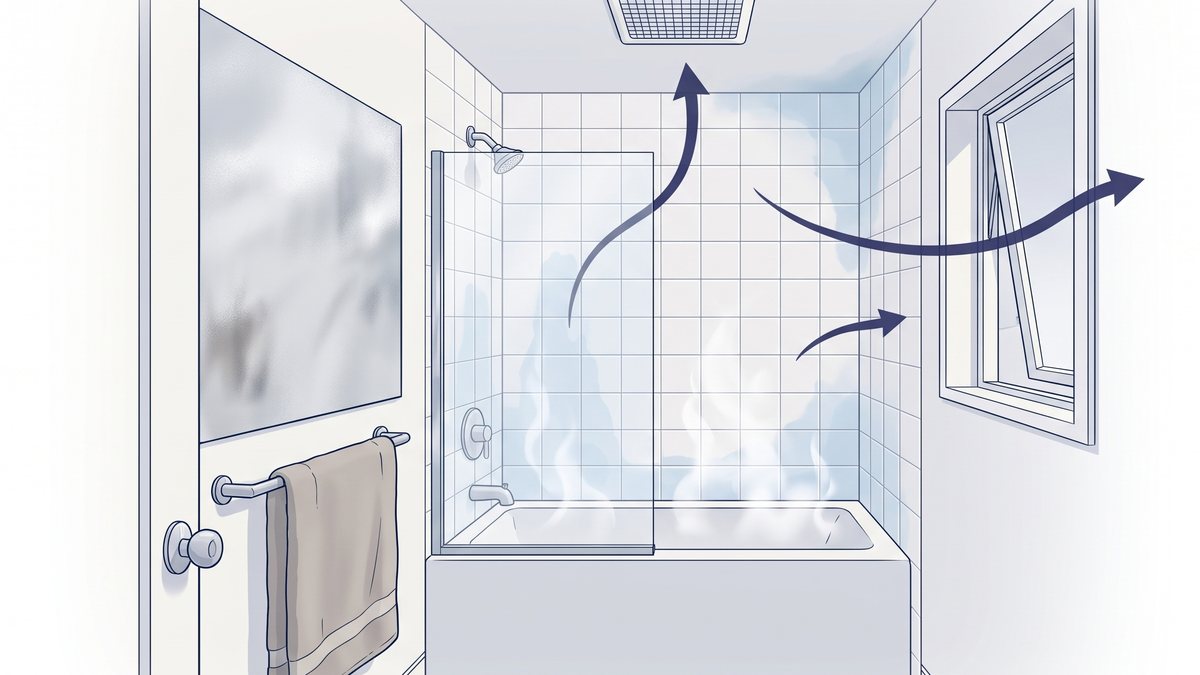
A shower nobody uses? The same British guidance tells buildings to flush little-used taps and showers weekly, without spraying the water around.17 At home, run a guest shower for a couple of minutes once a week, with the fan on, and stand back while it runs.
When should you replace a shower head?
When cleaning stops working, or when someone at home is at higher risk.
- The holes stay blocked after a soak and a pin. The New Jersey Department of Health lists buying a new shower head as the alternative to cleaning.15
- Black crumbs keep coming from it. Try a new washer or O-ring first, ideally one rated chloramine-resistant.1,2
- Someone at home has a weakened immune system. Every couple of years, as a precaution, per the University of Washington's Cangelosi.12
A shower head is one wet spot. The fan, the walls and the towels decide the rest.
First access and new guides, by email.
Get first access. And the lab results.
You're on the list. Your first email is on its way.
Questions
Is the black stuff in my shower head mold?
Sometimes, but the slime inside a shower head is mostly bacteria, according to the DNA studies.6,7 Mold grows wherever spores land on a damp spot, the EPA says, so black spots on the outside of a fixture can be mold.18 For mold on grout, caulk or the ceiling, see our guide to mold in the bathroom.
What's the pink stuff on my shower head?
Usually bacteria, the same pink film that grows on grout and in toilet bowls.5 See our guide to the pink slime in your shower and toilet.
Should I worry about viruses in my shower head?
Is a plastic or metal shower head better?
In one 2018 study of 656 homes, mycobacteria made up about half as much of the bacteria in plastic shower heads as in metal ones.7 It's a single study of relative amounts, so keep whichever head you like and clean it every few months.
Keep reading
Sources (19)
- Loudoun Water. "Drinking Water Quality FAQs" (Water Appearance: White Particles, Black Particles). Loudoun Water, Ashburn, Virginia, n.d. loudounwater.org
- Prince William Water. "What are the black specks in my tap water?" Prince William Water, Virginia, n.d. princewilliamwater.org
- US Geological Survey. "Hardness of Water." USGS Water Science School, n.d. usgs.gov
- US Environmental Protection Agency. "Secondary Drinking Water Standards: Guidance for Nuisance Chemicals." EPA, last updated May 26, 2026. epa.gov
- City of Norfolk, Virginia. "Why Do I Have Pink Stains on My Fixtures?" City of Norfolk, n.d. norfolk.gov
- Feazel L.M., Baumgartner L.K., Peterson K.L., Frank D.N., Harris J.K., Pace N.R. "Opportunistic pathogens enriched in showerhead biofilms." Proceedings of the National Academy of Sciences 2009;106(38):16393–16399. pmc.ncbi.nlm.nih.gov doi.org
- Gebert M.J., Delgado-Baquerizo M., Oliverio A.M., Webster T.M., Nichols L.M., Honda J.R., Chan E.D., Adjemian J., Dunn R.R., Fierer N. "Ecological analyses of mycobacteria in showerhead biofilms and their relevance to human health." mBio 2018;9(5):e01614-18. pmc.ncbi.nlm.nih.gov doi.org
- Cooperative Institute for Research in Environmental Sciences (CIRES), University of Colorado Boulder. "Your Showerhead Slime is Alive—and Mostly Harmless." CIRES news, November 1, 2018. cires.colorado.edu
- Huttelmaier S., Shuai W., Sumner J.T., Hartmann E.M. "Phage communities in household-related biofilms correlate with bacterial hosts." Frontiers in Microbiomes 2024;3:1396560. pmc.ncbi.nlm.nih.gov doi.org
- Morris A. "Viruses are teeming on your toothbrush, showerhead." Northwestern Now, Northwestern University, October 9, 2024. news.northwestern.edu
- Centers for Disease Control and Prevention. "About Nontuberculous Mycobacteria (NTM) Infections." CDC, June 12, 2025. cdc.gov
- Abramo A. "The bacteria in your shower." Department of Environmental & Occupational Health Sciences, University of Washington School of Public Health, October 22, 2019. deohs.washington.edu
- Tzou C.L., Dirac M.A., Becker A.L., Beck N.K., Weigel K.M., Meschke J.S., Cangelosi G.A. "Association between Mycobacterium avium complex pulmonary disease and mycobacteria in home water and soil." Annals of the American Thoracic Society 2020;17(1):57–62. pmc.ncbi.nlm.nih.gov doi.org
- National Jewish Health. "Is Your Shower Head Making You Sick?" (infographic, reviewed by David E. Griffith, MD, March 2024). National Jewish Health. nationaljewish.org
- New Jersey Department of Health. "Guidance for Removing and Cleaning a Shower Head." NJDOH, n.d. nj.gov
- New Jersey Department of Health, Environmental & Occupational Health Surveillance Program. "Hazard Alert: Mixing Bleach with Other Cleaning Products Can Be Deadly." NJDOH, n.d. nj.gov
- Health and Safety Executive (UK). "Hot and cold water systems: things to consider." HSE, updated September 26, 2024. hse.gov.uk
- US Environmental Protection Agency. "A Brief Guide to Mold, Moisture and Your Home." EPA, last updated February 18, 2026. epa.gov
- American Standard. "How to Clean a Shower Head." American Standard, n.d. (a shower-head maker's own care instructions for its own products; cited only for the bag method) americanstandard-us.com